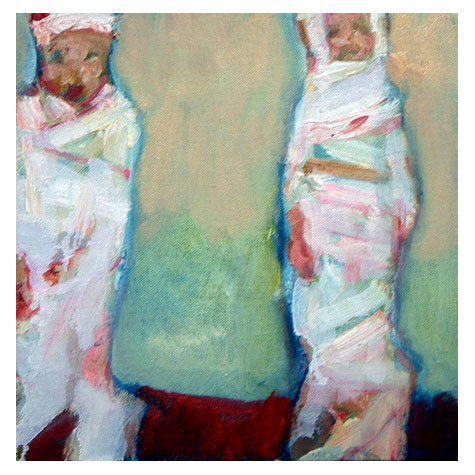
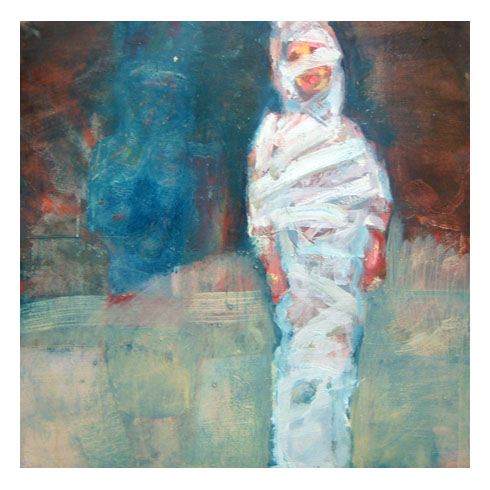
The Yoruba believe that each person has a Guardian Spirit called an "Orisha". Orisha are aspects of the Supreme Being that are manifested as forces of nature. When Yoruba slaves were brought to the New World they brought their beliefs with them. This belief system is known as "Santeria" in Cuba and as “Candomble” in Brazil.The Orishas are considered “saints” responsible for different parts of life with attributes and myths attached.Three freed female slaves in Brazil began worshiping the forbidden African religion by merging Orishas with Catholic Saints.Slaves in America were criminalized for practicing their religion. It is said that is why Brazil got the Samba and America got the Blues… New Abstract floodscape series The Floating City: New Orleans After the Flood paintings about the world turned upside down and the longing for home
In 2006, I responded to Hurricane Katrina with a series of abstract 'floodscapes' After the Flood. Three years later, I revisit the ninth ward with The Floating City. The impossibility of painting the physical reality of the flood allowed me to focus on the emotional reality of an inexorably altered world. My primary goal is to convey the sense of devastation and loss as well as to offer hope forthe city of New Orleans, rising.
on display on the mezzanine gallery at Arterra through May 25th. Arterra San Francisco's first LEED-certified green high-rise community. 300 Berry at 5th one block from the ballpark
The Yoruba believe that each person has a Guardian Spirit called an "Orisha". Orisha are aspects of the Supreme Being manifested as forces of nature. When Yoruba slaves came to the New World they brought their beliefs with them. This belief system is known as "Santeria" in Cuba and as “Candomble” in Brazil.
The Orishas are considered “saints” responsible for different parts of life with attributes and myths attached. Freed female slaves in Brazil began worshiping the forbidden African religion by merging Orishas with Catholic Saints. In America, these slaves were criminalized for practicing their religion. It is said that is why Brazil got the Samba and America got the Blues…
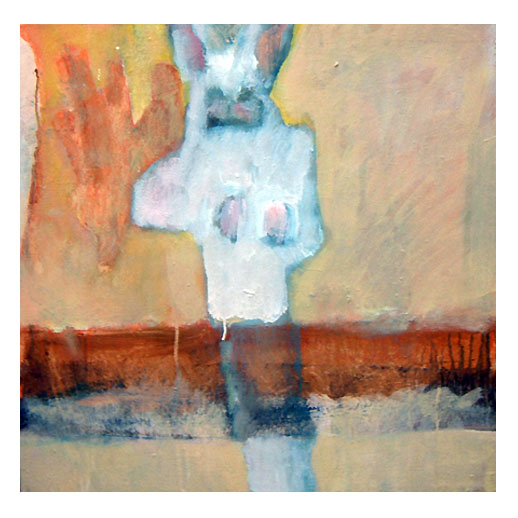
Oxum the orisha of sweetwater 36 x 36 oil 09
Oxum's dance recalls her bathing in a waterfall, and summoning the forces that control pregnancy and childbirth. The young woman possessed by Oxum dances alongside her mother.
Oxum likes beauty, and devotes her life to it. She is also the goddess of love and fertility, and looks after newborns . The city of Salvadore in Brazil is believed to be run by Oxum; it is said its people love the good things in life.
Oxum's festival Candomblé practitioners believe that every person has an individual orixa which controls his or her destiny and acts as a protector. Each orixa represents a force in nature and is associated with certain foods, colours, animals and days of the week
. The girl with her toes painted yellow for Oxum, the little sun, and the word for power—axé— Procreation, beauty, riches, love, and fertility. The mistress of jewels and fresh water. This is Oxum
Who is Alice Shaw? review of Auto (biography) at Gallery 16
There was palpable excitement in the crowded room as people hovered around a table, dropping five bucks into a jar, waiting to get their handwriting analyzed.
I was intrigued by the invitation,, "Alice Shaw has employed others, such as a handwriting analyst, an astral chart expert, a reader of tea leaves and a psychic, to tell her information about herself …then taken what she has learned from these sessions and made artwork in response.
The show was part documentation of this process—her original handwritten show proposal and the letter the handwriting analyst wrote in response, a palm readers scribbled notes upon her handprint, a teacup and the notes “ future health problems”, childlike watercolors and photos of the artist in various personas, interspersed with pairs of photographs and prints expressing dichotomies.
The first piece that caught my eye was face print of my colors, made by pressing paper onto her made up face….faint and wrinkled like a mounted skin, ghostly, yet still bearing the imprint of the artist.
in that sad fleeting visage; mystery.
On my second tour around the gallery I focused on the photographs; distilled, mature, enigmatic, coming finally to a watercolor series of illustrated magic tricks suggesting things are not always what they seem.
I returned to a framed envelope with a lipstick kiss on the back. Why I wondered, in a room full of artworks priced under $1000 was a lipstick kiss on the back on an envelope priced at $10,000? The difference in price was disjointing and made me consider the possibility that the price was an intentional artifice, a clue requiring that I pay attention.
The envelope, mounted in a simple black frame, incongruously almost, freezing in time, that particular kiss: until it became a symbol of a kiss which contained the promise of entering into another, and through them the hope of becoming complete; of understanding the unknowable you. Consider that most tricky of mirrors, love. The desire to be seen through the eyes of another, as much an illusion in the quest to know ourselves as a Russian woman reading your palm.
(Auto) biography uses our own fascination with ourselves to lure us in, as if through her exploration of identity we might be let in on the secret.
A friend commented that the work was hung too low, unevenly and looked unprofessional. My impression was that this was a deliberate choice serving to put the viewer at ease, by making the presentation more accessible, like a model with a chipped tooth. In their imperfection you recognize their humanity, as such I felt the way the show was curated beckoned the viewer to an intimate place, as if whispering, "You can be yourself here." We have our handwriting analyzed, see if we can predict the color of the next gumball out of the machine before we realize she’s winking back at us, as if saying; you don't really believe that stuff, do you?
"He who does not at some time, with definite determination consent to the terribleness of life, or even exalt in it, never takes possession of the inexpressible fullness of the power of our existence." r.m.r.Oya
Ruler of winds and whirlwinds. She rules over the dead and the gates of the cemeteries. She is a fierce warrior and was once the wife of Chango. She represents Our Lady of the Presentation of Our Lord and St. Theresa.
"Turn therefore from the common themes to those which your everyday life affords; depict your sorrows and desires, your passing thoughts and belief in some kind of beauty -depict all that with heartfelt, quiet, humble sincerity and use to express yourself the things that surround you." Rainer Maria Rilke
I am considering an exploration not only of the changed landscape, but also the Katrina refugees and how I can convey this unique event through the figure in a painting. I am thinking about gesture and posture and ways these express loss.
I am very excited about the concept of remains and debris. What has become of all the stuff we accumulate. I began some Fine China and Chandelier Flood paintings which I like because in the floating object we lose our normal frame of reference, allowing the form to signify the sense of dislocation which is the emotion informing the painting.
I started to look at photos of the Ninth Ward which I had not referenced at all when creating my first series of Flood paintings for AFTER THE FLOOD @ The Drugstore Gallery. This show was reviewed on March 30 2006 on www.Pacificnoise.com. Thanks to Sarah and John for the great podcast interview)
Although I am painting from my imagination in response to Hurricane Katrina, with the concept of The Flood as catalyst, I was struck by the way water had twisted metal and wood, forcing familiar objects out of context. A photo of a house bent in such a way it swirled leads me to more and more abstraction and ambiguity in my work.
I have six weeks to create 16 new paintings for Flood series II: Remains & Debris on display with http://www.griffindavisart.com at 2223 Market from July 8th-September 8th 2006. The restaurant will host the Reception from 5:30-8pm on July 13th 2006
Known as "Santeria" in Cuba and as “Candomble” in Brazil. The Orishas are considered Santos “saints” responsible for different parts of life with different attributes and myths attached.Three freed female slaves in Bahia Salvador, Brazil began worshipping the forbidden African religion by merging Orishas with Catholic Saints until they were allowed to worship freely. Slaves in America were criminalized for practicing their religion. It is said that is why Brazil got the Samba and the America got the Blues…
Changó’s favorite wife, she left his brother, the blacksmith Ogun, after he tried to force her to work in his forge, but not before stealing his tools (customarily seen as adornments for her crown). She fights next to Changó in war, and she guards the gates to the cemetery as well as to the marketplace; she is the hurricane that destroys in order to create. Her relationship to the ancestors is indexed by the use of rainbow colors in the clothing of her initiates and in altar displays.
There is a difference between making an icon, and having it become the object of worship, and making a representation that expresses a truth about God. We cannot depict the Father, the Holy Spirit, or the Trinity. .Herein lies the contradiction of faith, invisible and boundless, yet evidenced through our very real humanity. I became a santera: a saint maker; interpreting the holy moments of each day through a Child's eye.I'm fascinated by the Trinity as a metaphor for aspects of ourselves- If we reveal our spiritual nature when we release our sense of separateness from one another, then it is inevitable that in each new work, the figures grew increasing similar and androgynous.
The Yoruba believe that each person has a Guardian Spirit called an "Orisha". Orisha are aspects of the Supreme Being that are manifested as forces of nature. When Yoruba slaves were brought to the New World they brought their beliefs with them. This belief system is known as "Santeria" in Cuba and as “Candomble” in Brazil. The Orishas are considered Santos “saints” responsible for different parts of life with different attributes and myths attached.
Three freed female slaves in Bahia Salvador, Brazil began worshipping the forbidden African religion by merging Orishas with Catholic Saints until they were allowed to worship freely. Slaves in America were criminalized for practicing their religion. It is said that is why Brazil got the Samba and America got the Blues…
By Nicolaus Mills reference material for the floating city series
.Polidori’s New Orleans is an after-the-flood disaster of biblical proportions that continually challenges our sense of how the world is supposed to look.
Cars stand upside down, their rear bumpers leaning against the gutter of a roof. Uprooted trees rest on houses that seem as if they were built from a plywood kit. Polidori’s post-flood New Orleans is a collage of random disorder. Nothing is where it should be. Most revealing are the domestic interiors Polidori has so carefully photographed. In “6328 North Miro Street,” a four-poster bed filled with mud looks as if it had been covered in fudge. In “North Robertson Street,” the steel blades of a ceiling fan droop like the withered petals of a flower. In “Tupelo Street,” a rack of clothes hangs neatly in a closet despite the fact that the room the clothes are in is missing its exterior wall. In “1401 Pressberg Street,” living room furniture appears as if it had been rearranged by an angry giant, while on an undamaged coffee table, a new telephone sits pristinely in its box.
in Polidori’s “New Orleans After the Flood,” we cannot make sense of anything that happened. In removing people from his photographs, in labeling houses by their street number rather than by their owners’ names, Polidori has made it clear that in his judgment Hurricane Katrina was all-powerful once it struck land. Everyone in its path was temporarily rendered anonymous.
This coerced anonymity has not prevented Polidori from emphasizing how hard Katrina was on the poor. In the interiors that he photographed, Polidori is not embarrassed to point out that so many New Orleans residents caught in the flood never owned very much in the first place. The litter that Polidori’s camera has captured is dominated by close-ups of old television sets, mismatched couches, beaten-up tables and chairs—furniture that was disposable long before it was ruined.
There is also a politics of empathy . He puts us inside the homes that the victims of Hurricane Katrina no longer occupy, leaving what should be done next to our imaginations. His bet is that we will see, as he has, that no family subjected to such trauma can be expected to restart its life without first getting the kind of help that government alone can provide for coping with disaster on this scale.




 erosion