the lifted veil,
the inability to soothe my child's pain
the series has been an elusive trickster unforthcoming,
hard as lifting rocks to find one good thing
MUSICAL ACCOMPAINMENT
influences,inspirations and musical accompianment to the series poor wayfaring strangers
WORKING NOTES / WAYFARIN STRANGER
For those interested in how a painting gets from here to there. I created these paintings in the late summer of 2009 for the opening of Coda after putting my daughter to bed, between the hours of 8pm and 4am. Alone in the drafty studio, I don two pairs of pants and extra socks and am most productive then, without interruption.
I created a playlist of songs I listened to over and over: The Wayfarin Stranger soundtrack consists of as many versions of Poor Wayfaring Stranger as I could find, Jack White’s live version (obsessively), Mad world, Lou Reed’s Perfect day, and pretty much everything by Jeffrey Luck Lucas.
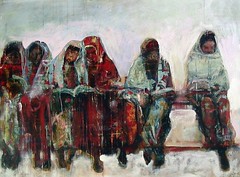
JULY 20 2009- the lifted veil,the inability to soothe my child's pain....the series has been an elusive trickster: unforthcoming, hard as lifting rocks to find one good thing
In this series I use gesture, color, and texture to explore the places where the broken and the transcendent meet. The paintings are unified by an emotional use of color, and by heavily worked surfaces which almost appear to have sustained water-damage. I re-use old paintings, actively "distressing" the surface by adding then scraping away layers to give each painting a history: histandingwoman.jpgdden then revealed, just below the surface. The way I work with paintings is to respond to what is evolving before me via the chance effects created by this process. My hope is to affirm a more authentic concept of beauty while making paintings which retain an evocation of mystery.
BadfishStudios Art Blog: Home
 barns in the middayu sun sold
waiting for godot
feeling much better, paintings coming along
.Working notes: for those interested in how a painting gets from here to there. I created these paintings in the late summer of 2009 for the opening of Coda after putting my daughter to bed, between the hours of 8pm and4am. Alone in the drafty studio, I don 2 pairs of pants and extra socks and am most productive then, without interruption.
I created a playlist of songs I listened to over and over: the series soundtrack:--as many versions of
I created a playlist of songs I listened to over and over: the series soundtrack:--as many versions of
Wayfaring Stranger as I could find, Jack White’s live version obsessively, Mad world, Lou Reed’s Perfect day and Jeffrey Luck Lucas.
The paintings are unified by color palette and emotional overtone-which is why the painting of three Monkeys looking expectantly upward is included among the other strangers, “going over Jordon, ... just going home.

just a perfect day
feeling much better, paintings coming along.
the you tube clips are the music i listened to while creating the series. listen. you will get a glimpse of the feelings conveyed through the music to the paint.
"Whom will you cry to, heart? More and more lonely,
your path struggles on through incomprehensible mankind.
All the more futile perhapsfor keeping to its direction,
keeping on toward the future,
toward what has been lost.
Once. You lamented...
What was it?
A fallen berry of jubilation, unripe.
But now the whole tree of my jubilation is breaking,
in the storm it is breaking,
my slow tree of joy.
Loveliest in my invisible landscape,
you that made me more known to the invisible angels." Rainier Maria Rilke
this sound sad as my heart
BadfishStudios Art Blog: Home
the you tube clips are the music i listened to while creating the series. listen. you will get a glimpse of the feelings conveyed through the music to the paint.
"Whom will you cry to, heart? More and more lonely,
your path struggles on through incomprehensible mankind.
All the more futile perhapsfor keeping to its direction,
keeping on toward the future,
toward what has been lost.
Once. You lamented...
What was it?
A fallen berry of jubilation, unripe.
But now the whole tree of my jubilation is breaking,
in the storm it is breaking,
my slow tree of joy.
Loveliest in my invisible landscape,
you that made me more known to the invisible angels." Rainier Maria Rilke
this sound sad as my heart
BadfishStudios Art Blog: Home
sorrow

my joys are equal only to my capacity for sorrow. in this deep well are the waters in which i swim to meet a shining and vibrating light, my constant companion through long nights. the job of the artist is to translate with conviction and clarity the inchoate longings we all feel for that which is authentic and true:to unravel the poetry of the soul.
"Like a saint's vision of beatitude. Like the veil of things as they seem drawn back by an unseen hand. For a second you see—and seeing the secret, are the secret. For a second there is meaning! Then the hand lets the veil fall and you are alone, lost in the fog again, and you stumble on toward nowhere, for no good reason! "
— Eugene O'Neill (Long Day's Journey into Night)
— Eugene O'Neill (Long Day's Journey into Night)

 priestess
Oxum orisha of beauty 36 x 36 oil 09
Oxum's dance recalls her bathing in a waterfall, and summoning the forces that control pregnancy and childbirth. The young woman possessed by Oxum dances alongside her mother.
Oxum likes beauty, and devotes her life to it. She is also the goddess of love and fertility, and looks after newborns up to the age of about 4. The city of Salvadore in Brazil is believed to be run by Oxum; it is said its people love the good things in life.

bahia salvador procession fesitival of oxum 36 x 36
Oxum's dance recalls her bathing in a waterfall, and summoning the forces that control pregnancy and childbirth. The young woman possessed by Oxum dances alongside her mother.
Oxum likes beauty, and devotes her life to it. She is also the goddess of love and fertility, and looks after newborns up to the age of about 4. The city of Salvadore in Brazil is believed to be run by Oxum; it is said its people love the good things in life.

bahia salvador procession fesitival of oxum 36 x 36
come see the beautiful world
Paintings celebrating the Orishas
Afro Carribean Mothers of Saint
New Abstract floodscape series
The Floating City: New Orleans After the Flood
paintings about the world turned upside down and the longing for home
In 2006, I responded to Hurricane Katrina with a series of abstract 'floodscapes' After the Flood. Three years later, I revisit the ninth ward with The Floating City. The impossibility of painting the physical reality of the flood allowed me to focus on the emotional reality of an inexorably altered world. My primary goal is to convey the sense of devastation and loss as well as to offer hope forthe city of New Orleans, rising.
on display on the mezzanine gallery at Arterra through May 25th.
Arterra San Francisco's first LEED-certified green high-rise community.
300 Berry at 5th one block from the ballpark

ORISHAS OXUM

 Paintings celebrating the Orishas Paintings celebrating the Orishas
Afro Carribean Mothers of Saint
  The Orishas are considered |
 Oxum the orisha of sweetwater 36 x 36 oil 09
Oxum's dance recalls her bathing in a waterfall, and summoning the forces that control pregnancy and childbirth. The young woman possessed by Oxum dances alongside her mother.
Oxum likes beauty, and devotes her life to it. She is also the goddess of love and fertility, and looks after newborns . The city of Salvadore in Brazil is believed to be run by Oxum; it is said its people love the good things in life.
Oxum's festival Candomblé practitioners believe that every person has an individual orixa which controls his or her destiny and acts as a protector. Each orixa represents a force in nature and is associated with certain foods, colours, animals and days of the week
. The girl with her toes painted yellow for Oxum, the little sun, and the word for power—axé— Procreation, beauty, riches, love, and fertility. The mistress of jewels and fresh water. This is Oxum
bahia salvador procession fesitival of oxum


-->
Who is Alice Shaw ? review of (auto ) biography at gallery 16
 faceprint of my colors
makeup on paper
 saw in thirds from magic tricks series
floating spoon from magic tricks series
 envelope 2009
lipstick , envelope
$10,000
 palm reading
black printers ink with readers notes
 tea leaf reading
teacup, cigarette butt
 the real alice shaw
tea photograph, my past left
landscape right
Who is Alice Shaw?
review of Auto (biography) at Gallery 16
There was palpable excitement in the crowded room as people hovered around a table, dropping five bucks into a jar, waiting to get their handwriting analyzed.
I was intrigued by the invitation,, "Alice Shaw has employed others, such as a handwriting analyst, an astral chart expert, a reader of tea leaves and a psychic, to tell her information about herself …then taken what she has learned from these sessions and made artwork in response.
The show was part documentation of this process—her original handwritten show proposal and the letter the handwriting analyst wrote in response, a palm readers scribbled notes upon her handprint, a teacup and the notes “ future health problems”, childlike watercolors and photos of the artist in various personas, interspersed with pairs of photographs and prints expressing dichotomies.
The first piece that caught my eye was face print of my colors, made by pressing paper onto her made up face….faint and wrinkled like a mounted skin, ghostly, yet still bearing the imprint of the artist.
in that sad fleeting visage; mystery.
On my second tour around the gallery I focused on the photographs; distilled, mature, enigmatic, coming finally to a watercolor series of illustrated magic tricks suggesting things are not always what they seem.
On my second tour around the gallery I focused on the photographs; distilled, mature, enigmatic, coming finally to a watercolor series of illustrated magic tricks suggesting things are not always what they seem.
I returned to a framed envelope with a lipstick kiss on the back. Why I wondered, in a room full of artworks priced under $1000 was a lipstick kiss on the back on an envelope priced at $10,000? The difference in price was disjointing and made me consider the possibility that the price was an intentional artifice, a clue requiring that I pay attention.
The envelope, mounted in a simple black frame, incongruously almost, freezing in time, that particular kiss: until it became a symbol of a kiss which contained the promise of entering into another, and through them the hope of becoming complete; of understanding the unknowable you. Consider that most tricky of mirrors, love. The desire to be seen through the eyes of another, as much an illusion in the quest to know ourselves as a Russian woman reading your palm.
(Auto) biography uses our own fascination with ourselves to lure us in, as if through her exploration of identity we might be let in on the secret.
A friend commented that the work was hung too low, unevenly and looked unprofessional. My impression was that this was a deliberate choice serving to put the viewer at ease, by making the presentation more accessible, like a model with a chipped tooth. In their imperfection you recognize their humanity, as such I felt the way the show was curated beckoned the viewer to an intimate place, as if whispering, "You can be yourself here." We have our handwriting analyzed, see if we can predict the color of the next gumball out of the machine before we realize she’s winking back at us, as if saying; you don't really believe that stuff, do you?
comment and photos by georgianne fastaia for www.artbusiness.com
apologies for the flash/glare
alice shaw
BadfishStudios Art Blog: Home
oyo Ruler of winds and whirlwinds.

"He who does not at some time, with definite determination consent to the terribleness of life, or even exalt in it, never takes possession of the inexpressible fullness of the power of our existence." r.m.r.Oya
Ruler of winds and whirlwinds.She rules over the dead and the gates of the cemeteries. She is a fierce warrior and was once the wife of Chango. She represents Our Lady of the Presentation of Our Lord and St. Theresa.
Flood series II Remains & Debris
Georgianne Fastaia - BadfishStudios Fine Art
I am thinking about gesture and posture and ways these express loss.
I am very excited about the concept of remains and debris. What has become of all the stuff we accumulate. I began some Fine China and Chandelier Flood paintings which I like because in the floating object we lose our normal frame of reference, allowing the form to signify the sense of dislocation which is the emotion informing the painting.
I started to look at photos of the Ninth Ward which I had not referenced at all when creating my first series of Flood paintings for AFTER THE FLOOD @ The Drugstore Gallery. This show was reviewed on March 30 2006 on www.Pacificnoise.com. Thanks to Sarah and John for the great podcast interview)
Although I am painting from my imagination in response to Hurricane Katrina, with the concept of The Flood as catalyst, I was struck by the way water had twisted metal and wood, forcing familiar objects out of context. A photo of a house bent in such a way it swirled leads me to more and more abstraction and ambiguity in my work.
I have six weeks to create 16 new paintings for Flood series II: Remains & Debris on display with http://www.griffindavisart.com at 2223 Market from July 8th-September 8th 2006. The restaurant will host the Reception from 5:30-8pm on July 13th 2006
"Turn therefore from the common themes to those which your everyday life affords; depict your sorrows and desires, your passing thoughts and belief in some kind of beauty -depict all that with heartfelt, quiet, humble sincerity and use to express yourself the things that surround you." Rainer Maria Rilke
I am considering an exploration not only of the changed landscape, but also the Katrina refugees and how I can convey this unique event through the figure in a painting.I am thinking about gesture and posture and ways these express loss.
I am very excited about the concept of remains and debris. What has become of all the stuff we accumulate. I began some Fine China and Chandelier Flood paintings which I like because in the floating object we lose our normal frame of reference, allowing the form to signify the sense of dislocation which is the emotion informing the painting.
I started to look at photos of the Ninth Ward which I had not referenced at all when creating my first series of Flood paintings for AFTER THE FLOOD @ The Drugstore Gallery. This show was reviewed on March 30 2006 on www.Pacificnoise.com. Thanks to Sarah and John for the great podcast interview)
Although I am painting from my imagination in response to Hurricane Katrina, with the concept of The Flood as catalyst, I was struck by the way water had twisted metal and wood, forcing familiar objects out of context. A photo of a house bent in such a way it swirled leads me to more and more abstraction and ambiguity in my work.
I have six weeks to create 16 new paintings for Flood series II: Remains & Debris on display with http://www.griffindavisart.com at 2223 Market from July 8th-September 8th 2006. The restaurant will host the Reception from 5:30-8pm on July 13th 2006


Orisha Goddesses of Brazil
Brand new figurative series, CANDOMBLE: the Orisha Goddesses of Brazil |
Known as "Santeria" in
inspiration for ORISHA Series: CANDOMBLE

 | Oya Changó’s favorite wife, she left his brother, the blacksmith Ogun, after he tried to force her to work in his forge, but not before stealing his tools (customarily seen as adornments for her crown). She fights next to Changó in war, and she guards the gates to the cemetery as well as to the marketplace; she is the hurricane that destroys in order to create. Her relationship to the ancestors is indexed by the use of rainbow colors in the clothing of her initiates and in altar displays. |


![[image]](https://lh3.googleusercontent.com/blogger_img_proxy/AEn0k_vjl87QYdnRX0Om4HZo6diYUKk26jejkWn031PmjEP6c9ldc8eZ926f7GYPRFlNEsmMFxIrCFMuMKZKxedkFDRSIxx4rf_h_sCHbvMQpHgeWTxaXOuYFKij6zVyxLTUoSDiS6bLVAWKlyBrOqzZYUKD0g=s0-d)


flood paintings
BadfishStudios Art Blog: Home

Bayou 1 30x30 oil 09
The Floating City series

Bayou 2 30x30 oil 09
The Floating city Series
Home: Georgianne Fastaia - BadfishStudios Fine Art

Trinidad 20 x 20 oil 08 SOLD

trinity 36 x 36 oil 08 sold

detail, black madonna sold


Home: Georgianne Fastaia - BadfishStudios Fine Art


mother of saint 36 x 36 oil 09
 detail "Mother of Saint"
 oxum admiring her reflection 30 x 30 oil 09
Home: Georgianne Fastaia - BadfishStudios Fine Art
12/4/08
latest flood paintings

Bayou 1 30x30 oil 09
The Floating City series

Bayou 2 30x30 oil 09
The Floating city Series
Home: Georgianne Fastaia - BadfishStudios Fine Art
11/8/08
Santeras

Trinidad 20 x 20 oil 08 SOLD

trinity 36 x 36 oil 08 sold

detail, black madonna sold
Personal icons as everyday saints
There is a difference between making an icon, and having it become the object of worship, and making a representation that expresses a truth about God. We cannot depict the Father, the Holy Spirit, or the Trinity. .Herein lies the contradiction of faith, invisible and boundless, yet evidenced through our very real humanity. I became a santera: a saint maker; interpreting the holy moments of each day through a Child's eye.I'm fascinated by the Trinity as a metaphor for aspects of ourselves- If we reveal our spiritual nature when we release our sense of separateness from one another, then it is inevitable that in each new work, the figures grew increasing similar and androgynous.
11/4/08
return to Abstract Figurative Work

By the lake
36 x 24 oil 09

Dreaming of tightrope and trapeze
36 x 36 oil 09Home: Georgianne Fastaia - BadfishStudios Fine Art
11/3/08
Harajuku Station
Harajuku Girls at Artist-Xchange Gallery

girl at harajuku station 42 x 42 oil 2008
new paintings from my series Harajuku Dixie Cup
inspired by the pop culture in tokyo's Harajuku district

girl at harajuku station 42 x 42 oil 2008
new paintings from my series Harajuku Dixie Cup
inspired by the pop culture in tokyo's Harajuku district
11/1/08
latest orisha paintings march


mother of saint 36 x 36 oil 09
 detail "Mother of Saint"
 oxum admiring her reflection 30 x 30 oil 09
Paintings celebrating the Orishas
Afro Carribean Mothers of Saint
The Yoruba believe that each person has a Guardian Spirit called an "Orisha". Orisha are aspects of the Supreme Being that are manifested as forces of nature. When Yoruba slaves were brought to the New World they brought their beliefs with them. This belief system is known as "Santeria" in Cuba and as “Candomble” in Brazil. The Orishas are considered Santos
Three freed female slaves in Bahia Salvador, Brazil began worshipping the forbidden African religion by merging Orishas with Catholic Saints until they were allowed to worship freely. Slaves in America Brazil got the Samba and America

Home: Georgianne Fastaia - BadfishStudios Fine Art
robert polidori new orleans after the flood
 erosion
fading city

ruins
By Nicolaus Mills reference material for the floating city series

.Polidori’s New Orleans is an after-the-flood disaster of biblical proportions that continually challenges our sense of how the world is supposed to look.
Cars stand upside down, their rear bumpers leaning against the gutter of a roof. Uprooted trees rest on houses that seem as if they were built from a plywood kit. Polidori’s post-flood New Orleans is a collage of random disorder. Nothing is where it should be.
Most revealing are the domestic interiors Polidori has so carefully photographed. In “6328 North Miro Street,” a four-poster bed filled with mud looks as if it had been covered in fudge. In “North Robertson Street,” the steel blades of a ceiling fan droop like the withered petals of a flower. In “Tupelo Street,” a rack of clothes hangs neatly in a closet despite the fact that the room the clothes are in is missing its exterior wall. In “1401 Pressberg Street,” living room furniture appears as if it had been rearranged by an angry giant, while on an undamaged coffee table, a new telephone sits pristinely in its box.
in Polidori’s “New Orleans After the Flood,” we cannot make sense of anything that happened. In removing people from his photographs, in labeling houses by their street number rather than by their owners’ names, Polidori has made it clear that in his judgment Hurricane Katrina was all-powerful once it struck land. Everyone in its path was temporarily rendered anonymous.
This coerced anonymity has not prevented Polidori from emphasizing how hard Katrina was on the poor. In the interiors that he photographed, Polidori is not embarrassed to point out that so many New Orleans residents caught in the flood never owned very much in the first place. The litter that Polidori’s camera has captured is dominated by close-ups of old television sets, mismatched couches, beaten-up tables and chairs—furniture that was disposable long before it was ruined.
There is also a politics of empathy . He puts us inside the homes that the victims of Hurricane Katrina no longer occupy, leaving what should be done next to our imaginations. His bet is that we will see, as he has, that no family subjected to such trauma can be expected to restart its life without first getting the kind of help that government alone can provide for coping with disaster on this scale.
Subscribe to:
Posts (Atom)